


How Can a Parent in Wylie or Rockwall Help a Child Who Refuses to Go to School Because of Anxiety?
If your child is in tears every morning before the school bus arrives, complaining of stomachaches that disappear by noon, or completely shutting down at the mention of class, you are not imagining things and you are not failing as a parent. School refusal driven by anxiety is one of the most exhausting situations a family can face, and it is showing up with increasing frequency across Rockwall County, Wylie, Fate, and surrounding communities. The good news is that it responds well to the right kind of support. Understanding what is actually happening for your child is the first step toward getting your mornings back.
What School Refusal Actually Looks Like (And Why It Is Not Just Defiance)
Many parents first wonder whether their child is being stubborn, manipulative, or simply trying to get out of homework. Sometimes those things are part of the picture. But in a large number of cases, school refusal is rooted in genuine anxiety that the child does not have the words or the tools to manage on their own.
School refusal can look different depending on the child’s age and temperament. In younger children, you might see clinging, crying, vomiting, or tantrums at drop-off. In older kids and tweens, it may appear as prolonged morning meltdowns, repeated visits to the school nurse, or simply refusing to get out of the car. Some children will attend school but spend the whole day in the counselor’s office or the restroom, unable to settle into the classroom environment.
Common anxiety triggers behind school refusal include fear of social judgment, worry about academic performance, separation anxiety, a difficult peer relationship, or sensitivity to sensory overwhelm in noisy hallways. High-achieving school cultures in Rockwall County, where academic expectations are real and college preparation starts early, can amplify these pressures in children who are already prone to anxiety.
Why This Problem Often Gets Worse Without Professional Support
When a child is distressed enough to refuse school, the natural parental instinct is to give them a day at home to calm down. That approach makes complete sense in the short term. But if the pattern continues, staying home can quickly become the coping strategy the child’s brain defaults to whenever anxiety spikes. Over time, the gap between the child and the school environment grows wider, and returning becomes genuinely harder.
This is not about blame. Parents are doing their best with a child who is suffering. But it does mean that the longer school refusal goes unaddressed, the more important it becomes to bring in professional guidance sooner rather than later.
School counselors do important work, but they are not licensed therapists and typically cannot provide the structured, evidence-based treatment that chronic school refusal requires. Generic advice from parenting blogs or well-meaning relatives usually falls short as well, because it does not account for what is specifically driving your child’s anxiety.
What Evidence-Based Therapy for School Refusal Actually Involves
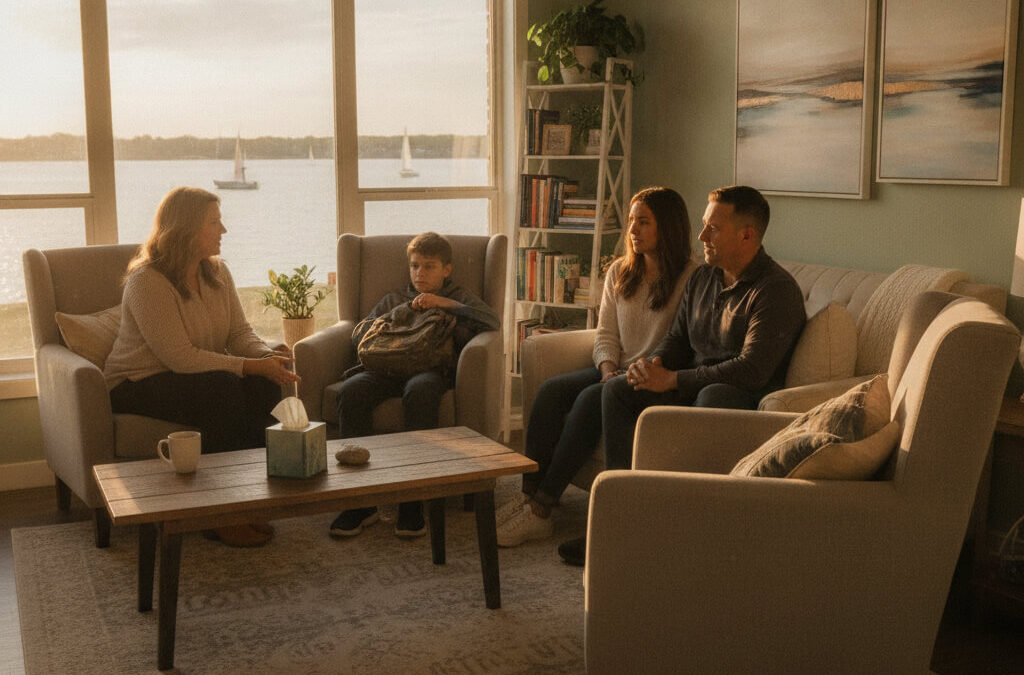
At Counseling for Healthy Minds in Rockwall, the licensed therapists who work with children use approaches that are matched to the child’s developmental stage and the specific nature of their anxiety. For many children, child counseling and play therapy provides a safe, non-threatening space to process fears and practice new responses without feeling put on the spot.
Cognitive Behavioral Therapy, or CBT, is one of the most well-researched approaches for anxiety in children and is a core part of how school refusal is treated. In practical terms, this means helping your child identify the thoughts that are feeding their fear, test whether those thoughts hold up to reality, and gradually build tolerance for the situations they have been avoiding. This gradual exposure process is done at a pace the child can manage, with consistent support from the therapist and from you as a parent.
Family involvement is not optional in school refusal cases. Parents learn how to respond to morning distress in ways that calm the nervous system rather than inadvertently reinforcing avoidance. When parents and therapists are working from the same playbook, children tend to progress faster.
A Section Competitors Are Missing: What to Do Right Now While You Wait for a Therapy Appointment
One gap that often goes unaddressed in mental health content for parents is the question of what to do in the days between recognizing the problem and getting into a therapist’s office. Here are a few concrete steps that licensed counselors recommend to parents while a formal evaluation is being arranged:
- Keep school attendance as the goal, not a punishment. Even if your child attends for only part of the day at first, maintaining some connection to the school environment helps prevent the avoidance cycle from deepening.
- Avoid lengthy morning negotiations. Prolonged debates about whether to go to school often increase anxiety rather than resolve it. A calm, matter-of-fact tone tends to work better than lengthy reassurance conversations.
- Communicate with the school. Let the teacher and school counselor know what is happening. Ask whether there is a low-stress entry point, like arriving early before the hallways fill up, or a trusted adult your child can check in with on hard mornings.
- Notice the physical symptoms without catastrophizing them. Stomachaches and headaches related to anxiety are real, not fake. Acknowledge how your child feels while also gently reinforcing that the body can handle the discomfort and that going to school is still the plan.
- Prioritize sleep. Anxiety and sleep disruption feed each other. A consistent bedtime routine, low screen exposure in the evenings, and a predictable morning schedule all support a calmer start to the day.
These strategies are starting points, not substitutes for professional evaluation. If your child’s distress is severe, escalating, or has been going on for more than a few weeks, a licensed therapist is the right next step.
How Counseling for Healthy Minds Supports Families in Wylie, Heath, Fate, and Rockwall
Counseling for Healthy Minds has served families across Rockwall County and the surrounding area for more than 25 years. The practice offers evening appointments until 7 p.m. and Saturday availability, which matters enormously for parents juggling work schedules and school pickups. For families in Wylie, Heath, Royse City, or other surrounding communities who cannot always make the drive, telehealth sessions are available across Texas so your child can meet with a licensed therapist from home.
Inquiries receive a response within 24 hours, and the team accepts major insurance plans including Aetna, Blue Cross Blue Shield, Cigna, UnitedHealthcare, UMR, and Tricare West, which is relevant for the military and veteran families in this region who are often navigating mental health care through that benefit. Anxiety therapy for children and teens is one of the practice’s core areas of focus, and the team is experienced in coordinating care with schools when it supports the child’s progress.
For families of faith, Christian counseling is available and can be integrated into your child’s treatment at whatever level feels right for your family. It is an option, never a requirement, and the approach is always guided by what will be most helpful for your child.
Frequently Asked Questions: School Refusal and Anxiety in Kids Near Rockwall
How do I know if my child’s school refusal is anxiety or something else?
Anxiety-driven school refusal is typically marked by physical symptoms in the morning that ease once the threat of school passes, intense emotional distress at drop-off, and a child who is otherwise engaged and happy at home. That said, school refusal can also be connected to learning difficulties, bullying, undiagnosed ADHD, depression, or other factors. A licensed therapist can help you sort through what is driving the behavior with a thorough assessment. Never try to diagnose your child based on an article alone.
Is it okay to let my child stay home when they are very upset?
An occasional mental health day handled thoughtfully is different from a recurring pattern. When staying home becomes the default response to anxiety, it tends to reinforce avoidance over time. A therapist can help you find the balance between compassion and consistent structure that fits your child’s specific situation.
Can a therapist in Rockwall work with my child’s school directly?
With a signed release from you as a parent, yes. Many therapists who specialize in school refusal will coordinate with teachers, school counselors, or administrators to create a consistent plan across both environments. This kind of team approach generally produces better outcomes than therapy alone.
My child refuses to talk in therapy. Will that be a problem?
Not with the right therapist. Play therapy is specifically designed for children who do not naturally open up through conversation. Through structured play, art, and other expressive activities, a skilled child therapist can build trust and help a child process anxiety in ways that feel safe and age-appropriate. Many children who start out silent become quite engaged once the relationship is established.
How long does it typically take to see improvement with school refusal therapy?
That depends on the child, the duration of the problem, and the approach being used. Some families notice meaningful shifts within a few weeks of consistent therapy, particularly when parents are also actively involved. More entrenched patterns may take longer. A licensed therapist can give you a clearer sense of what to expect after an initial evaluation.
Your Family Does Not Have to Figure This Out Alone
School refusal is one of those problems that tends to grow when it is managed in isolation and shrink when the right support is in place. If your child is struggling to get through the school door in the morning, whether you are in Wylie, Fate, Heath, Rockwall, or anywhere in between, the licensed team at Counseling for Healthy Minds is ready to help you understand what is happening and build a plan that actually works for your family.
Reaching out is simple. Contact Counseling for Healthy Minds today and you will hear back within 24 hours. Evening and Saturday appointments are available, telehealth is an option across Texas, and most major insurance plans are accepted. The first step is just letting us know you need support.