


Trauma Therapy & EMDR in Rockwall, TX
You Don't Have to Carry This Alone
- Licensed trauma therapists offering EMDR, trauma-informed care, and PTSD treatment. Proven approaches that get to the root, not just the symptoms
- Faith-based trauma counseling available, for clients who want healing that honors the whole person, body, mind, and spirit
- Insurance accepted including Aetna, BCBS, Cigna, Tricare West for military families, UHC, and more. Evening and Saturday appointments available

Something happened. And even though it is in the past. It does not feel like the past.
Maybe you know exactly what it was: the accident, the loss, the relationship that slowly dismantled your sense of reality, the childhood that never felt fully safe. Maybe you cannot name it as clearly as that. Just a constant undercurrent of dread, a body that startles at nothing, a brain that will not stop scanning for what might go wrong next.
Whatever it looks like for you: what you are carrying is real. And it does not have to stay this heavy.
At Counseling for Healthy Minds in Rockwall, TX, our licensed trauma therapists have spent more than 25 years helping people move through trauma, not around it, not over it, but genuinely through it. Using EMDR and trauma-informed care that is evidence-based, compassionate, and adapted to each person's specific experience, we help clients reclaim the life that trauma put on hold.
You have survived. Now it is time to heal.
Ready to take the first step toward healing?
Call or text Counseling for Healthy Minds at 469-769-1121, or book your first appointment online.
Evening hours until 7pm. Saturday appointments available. Insurance accepted, including Tricare West for military families.
- Trauma Therapy & EMDR
Understanding Trauma. Why It Gets Stuck and Why It Does Not Just Go Away
Here is something that changes the way most people think about their own experience: trauma is not about what happened to you. It is about what happened inside your nervous system when it did.
When an experience overwhelms the brain's normal processing capacity, it does not get stored the way ordinary memories do. Instead of being filed away as something that happened and is now over, the experience gets frozen. Incomplete, emotionally charged, carrying the original physical and emotional intensity of the moment. The brain treats it as still-present threat. That is why a sound, a smell, a look on someone's face can transport you back in an instant. That is why your body reacts before your mind has time to think.
It is not weakness. It is not "being stuck in the past." It is an unprocessed memory that your nervous system has been trying to protect you from, and it responds extraordinarily well to the right treatment.
At Counseling for Healthy Minds, we work with all types of trauma, including:
Post-Traumatic Stress Disorder (PTSD)
Following a specific traumatic event or series of events: accidents, assaults, natural disasters, medical emergencies. Flashbacks, nightmares, hypervigilance, avoidance, and emotional numbing are hallmarks.
Complex PTSD (C-PTSD)
Resulting from prolonged or repeated trauma, often in childhood or in intimate relationships where escape was limited. C-PTSD goes deeper than standard PTSD: it shapes identity, emotional regulation, and the ability to trust in ways that take dedicated, patient work to heal.
Childhood Trauma and Adverse Childhood Experiences (ACEs)
Abuse, neglect, household dysfunction, or emotional unavailability in caregivers. Adults carrying childhood trauma often present with depression, anxiety, relationship patterns, or emotional reactions they cannot fully explain, because the connection to what happened was never made.
Narcissistic Abuse Trauma
A specific, devastating form of complex trauma resulting from sustained psychological abuse in a relationship with a narcissistic partner, parent, or family member. Gaslighting, identity erosion, trauma bonding, and profound self-doubt are the aftermath. This is a named specialty at Counseling for Healthy Minds.
Betrayal Trauma
when trauma is inflicted by someone who was supposed to be safe: a partner's infidelity, a parent's abuse, an institution's failure to protect. The betrayal itself compounds the trauma response in ways that require specific therapeutic attention.
Combat and Military Trauma
PTSD, moral injury, and the specific presentations of trauma in veterans and active service members. Counseling for Healthy Minds accepts Tricare West, and our therapists are experienced with the unique demands of military trauma.
Medical Trauma
Resulting from a frightening or life-threatening medical experience, a serious diagnosis, emergency surgery, or traumatic medical procedures.
Grief-Related Trauma
when loss occurs suddenly, violently, or in circumstances that leave the surviving person in traumatic shock rather than able to grieve normally.
Accident and Injury Trauma
Car accidents, assaults, witnessing violence, or other traumatic events that leave a lasting imprint on the nervous system.
You do not need a dramatic single story to qualify for trauma treatment. You just need a nervous system that is still carrying something it could not finish processing, and a willingness to start.
- About Our Practice
What Is EMDR Therapy? The Science Behind Why It Works
If you have heard about EMDR, maybe from a friend, a podcast, or something you saw online, but are not entirely sure what it actually involves, you are not alone. It is one of the most talked-about therapies in mental health right now, and one of the most misunderstood. Let's clear that up.
EMDR stands for Eye Movement Desensitization and Reprocessing. It was developed by Dr. Francine Shapiro in the late 1980s and has since become one of the most extensively researched trauma treatments in the world. It is endorsed as a first-line treatment for PTSD by:
- The World Health Organization (WHO)
- The American Psychiatric Association (APA)
- The International Society for Traumatic Stress Studies (ISTSS)
- The U.S. Department of Veterans Affairs
That is not marketing language. That is the clinical consensus of the world's leading mental health bodies. EMDR works.

How Does EMDR Actually Work?
Trauma memories are stored differently from normal memories. Because the brain was overwhelmed at the time of the experience, it could not complete its usual information-processing sequence, so the memory got "frozen" in its original emotional state, retaining the physical sensations, negative beliefs, and emotional intensity of the original event.
EMDR uses bilateral stimulation — typically guided eye movements, but also tactile tapping or auditory tones — while the client holds the traumatic memory in mind. This dual attention activates the brain's natural information processing system and allows it to do what it could not do at the time: complete the processing cycle. The memory's emotional charge diminishes. It becomes integrated as something that happened — a past event — rather than an ongoing threat. The negative beliefs associated with it ("I am to blame," "I am not safe," "I am broken") are replaced with accurate, adaptive ones.
EMDR is not hypnosis. Clients remain fully conscious and in complete control throughout the session. The goal is not to make the memory disappear. It is to change the way the brain holds it, so that it stops triggering the body's threat response every time it surfaces.
The 8 Phases of EMDR
EMDR is structured across 8 phases that every trained therapist follows in sequence:
- Phase 1. History-taking: Understanding the client's full trauma history, current symptoms, and treatment goals.
- Phase 2. Preparation: Building coping skills, nervous system regulation techniques, and the therapeutic trust needed before processing begins. This phase is never skipped.
- Phase 3. Assessment: Identifying the specific memory to target, the negative belief associated with it, and the desired positive belief.
- Phase 4. Desensitization: The active reprocessing phase using bilateral stimulation while the client attends to the traumatic memory.
- Phase 5. Installation: Strengthening the positive belief that replaces the negative one.
- Phase 6. Body Scan: Checking for any remaining physical tension or distress held in the body.
- Phase 7. Closure: Ensuring the client is grounded and stable at the end of every session.
- Phase 8. Reevaluation: Reviewing progress at the start of subsequent sessions before continuing.
Single-incident PTSD typically shows significant improvement in 8 to 12 EMDR sessions. Complex trauma takes longer, and that is completely appropriate. The therapists at Counseling for Healthy Minds never rush the preparation phase. Moving too fast in trauma work risks re-traumatization. We will never let that happen.

What Is EMDR Therapy? Rockwall, TX's Guide to Evidence-Based Trauma Treatment
- EMDR reprocesses traumatic memories at the level where they are stored — not just talks about them — producing relief that is often faster and more durable than traditional therapy alone
- 8 structured phases, bilateral stimulation, and a trained licensed therapist. This is clinical science, not a trend
- Most clients with single-incident PTSD begin noticing meaningful relief within 8 to 12 sessions.
- Trauma Therapy & EMDR
Signs You May Be Carrying Unprocessed Trauma
One of the most common things we hear at Counseling for Healthy Minds is: "I was not sure if what I went through was bad enough to call it trauma." It was. Trauma is not defined by how dramatic your story sounds to someone else. It is defined by how your nervous system responded, and whether it ever got the chance to fully recover.
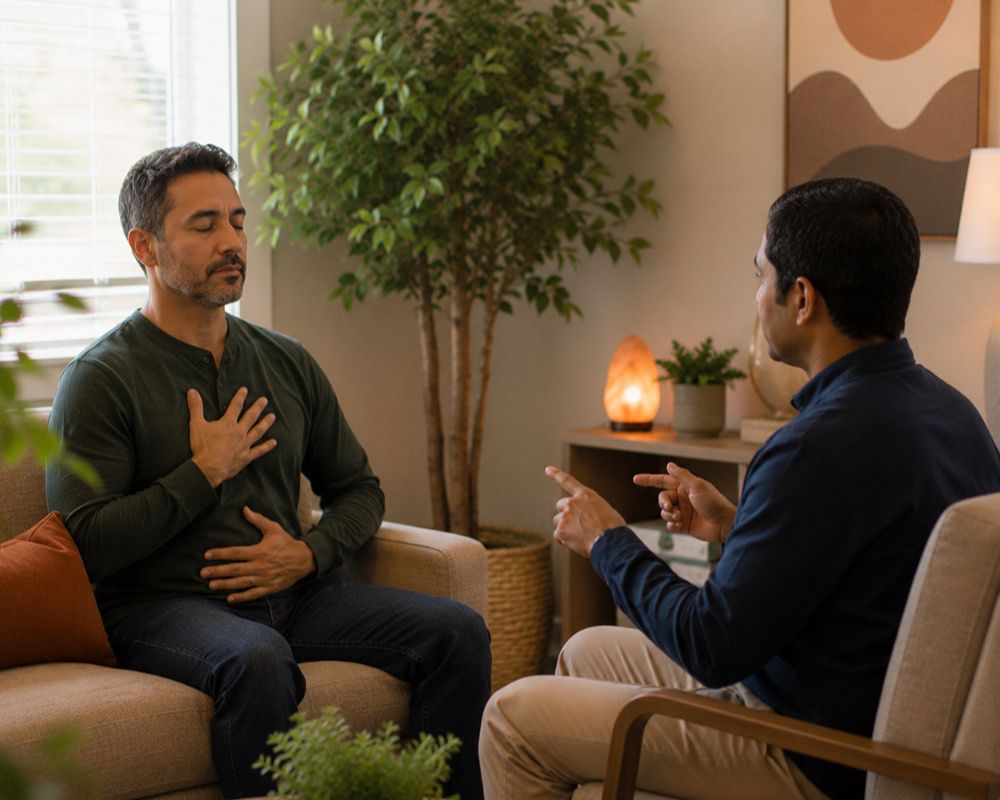
Here is what unprocessed trauma actually looks like in real life:
Intrusive Symptoms
- Flashbacks. Sudden, involuntary reliving of the traumatic experience as if it is happening now
- Nightmares or disturbing dreams related to the event
- Emotional flooding triggered by sights, sounds, smells, or situations that remind the nervous system of the original trauma
- Intrusive thoughts or images that surface without warning
Avoidance Symptoms
- Avoiding people, places, conversations, or activities that trigger memories of what happened
- Emotional numbing. Feeling detached, flat, or disconnected from life
- Loss of interest in things that used to matter
- Feeling like you are watching your own life from a distance rather than living it
Hyperarousal Symptoms
- Hypervigilance. Constantly scanning for danger, never fully able to relax
- Exaggerated startle response. Jumping at small sounds, always on edge
- Difficulty falling or staying asleep
- Irritability or explosive anger that feels disproportionate
- Difficulty concentrating, brain fog, or a mind that will not settle
Negative Cognition Symptoms
- "I am to blame." "I am broken." "I am permanently damaged." Distorted beliefs about yourself, others, and the world that the trauma installed, and that feel completely true even when they are not.
- Persistent shame, guilt, or self-blame that cannot be reasoned away
- Difficulty experiencing positive emotions. A sense of a foreshortened future, as if life will never really be good
Relational and Physical Symptoms
- Difficulty trusting people. Even people who have given you no reason not to
- Chronic people-pleasing, difficulty with boundaries, fear of abandonment
- Repeating relationship patterns that feel confusing or self-defeating
- Chronic muscle tension, unexplained physical pain, digestive issues, fatigue. The body holding what the mind could not process
If any of this resonates — even partially, even imperfectly — that is enough. You do not have to tick every box to deserve help. You just have to be tired of carrying it.

- Trauma Therapy & EMDR
Narcissistic Abuse Recovery in Rockwall, TX. A Specialized Form of Trauma
This section is for a specific person. You may or may not use the word "trauma" to describe what you went through. You might just know that a relationship — with a partner, a parent, a family member — left you doubting your own memory, your own judgment, and your own worth in ways that do not make sense to people on the outside.
The relationship may have looked fine from the outside. Maybe even enviable. Inside, you were walking on eggshells. Never sure what you did wrong this time, always trying to be better, always somehow responsible for how they felt. When it ended, or when you started to see it clearly, you discovered the damage went far deeper than heartbreak. You stopped trusting yourself. You stopped trusting your own perceptions. You wondered if you imagined it all.
You did not imagine it. And what happened to you has a name: narcissistic abuse trauma. A form of complex trauma that results from sustained psychological abuse including gaslighting, intermittent reinforcement, isolation, and identity erosion.
EMDR is particularly effective for narcissistic abuse trauma because it directly targets the negative core beliefs the experience installed: "I am not enough." "I cannot trust myself." "I am to blame." Through structured reprocessing, those beliefs are examined, challenged, and replaced with what is actually true about you.
Counseling for Healthy Minds has a dedicated Narcissistic Abuse Recovery service for clients navigating this specific form of trauma. You are not alone in this, and healing is not just possible. It is happening for people every week in our practice.
EMDR for PTSD and Narcissistic Abuse in Rockwall, TX. Finally Address the Root
- EMDR is proven effective for PTSD, complex trauma, narcissistic abuse, childhood trauma, and betrayal trauma. Addressing the root, not just the symptoms
- Our trauma-informed team treats the whole person: the psychological, relational, and spiritual dimensions of trauma recovery
- Crawford our therapy dog is part of the welcome experience. Even the most hyperactivated nervous systems find their first moment of calm before a session begins
- Trauma Therapy & EMDR
Our Approach to Trauma Treatment at Counseling for Healthy Minds
Trauma treatment is not one-size-fits-all. The nervous system that has lived through trauma needs safety before it can heal, and everything at Counseling for Healthy Minds begins there.
Every single session, before any processing work begins, we prioritize your sense of safety in the room. That means a therapeutic relationship built on genuine trust, a carefully structured treatment approach that never moves faster than you are ready to go, and a physical space designed to feel calming from the moment you walk in, including Crawford, our therapy dog, whose presence measurably lowers cortisol and helps even the most hypervigilant nervous systems find a moment of ease before a session begins.

EMDR. Our Primary Trauma Treatment
EMDR is the evidence-based foundation of trauma treatment at Counseling for Healthy Minds. It is available for adults, teens, and older children across all trauma types. PTSD, C-PTSD, narcissistic abuse, military trauma, childhood trauma, grief-related trauma, and more. Our therapists follow the structured 8-phase protocol developed by Dr. Francine Shapiro, adapted to the individual client's presentation, history, and pace.
Trauma-Focused CBT (TF-CBT) for Children and Adolescents
For children and teenagers who have experienced trauma, Trauma-Focused Cognitive Behavioral Therapy (TF-CBT) is the gold standard. TF-CBT combines trauma-sensitive cognitive processing with narrative work, coping skill development, and caregiver involvement to reduce PTSD symptoms in younger clients. It works in tandem with the child counseling and teen counseling services at Counseling for Healthy Minds.
Trauma-Informed Care as a Practice Standard
Every clinician at Counseling for Healthy Minds practices through a trauma-informed lens, not just the therapists who specialize in trauma treatment. This means that clients presenting with anxiety, depression, relationship issues, or any other concern are treated by therapists who understand how adverse experiences shape current presentations. You will never have to worry about being handled in a way that inadvertently causes harm.
Faith-Based Trauma Counseling
Trauma does not only wound psychologically. For many people — especially in a community as faith-oriented as Rockwall — it wounds spiritually. The theological question of "why did God allow this?" The loss of faith following abuse in a religious context. The moral injury carried by veterans. The spiritual manipulation sometimes present in narcissistic relationships, where faith itself was weaponized as a tool of control.
Counseling for Healthy Minds is a faith-based practice, and those spiritual dimensions of trauma have a place in the therapy room here. Christian values, prayer, and scripture can be genuinely integrated into trauma treatment for clients who want that. Alongside evidence-based EMDR. For clients who prefer a secular clinical approach, you are fully welcome and fully cared for. The faith option is always available. It is never assumed or required.

- Trauma Therapy & EMDR
Licensed Trauma Therapists Serving Rockwall, TX
Trauma work requires more than a license. It requires specific training, genuine clinical skill, and a therapeutic relationship strong enough to hold the weight of what a client is bringing into the room. Here is the team at Counseling for Healthy Minds.

Anita Henrichson, MBS, LPC-S. Founder & Clinical Supervisor
Anita Henrichson has been a Licensed Professional Counselor Supervisor (LPC-S) since 1999. More than 25 years of clinical experience. Working with adults, teens, and children navigating trauma, anxiety, depression, and the full complexity of human suffering. As the founder and clinical supervisor of Counseling for Healthy Minds, she sets the clinical standard for the entire practice. She personally oversees the therapeutic work of every clinician on the team, ensuring that the quality of care delivered in every room meets the standard she has spent her career building.
For 12 years, Anita hosted the "Christian Counseling Today" radio show. Speaking directly to thousands of Rockwall-area families about mental health, trauma, and faith-integrated healing. That level of sustained community presence and clinical authority is rare. It is also exactly why the families of Rockwall County have trusted Counseling for Healthy Minds for over two decades.

Nichole Jackson, MA, LPC. Clinician & Adolescent Specialist
Nichole Jackson is a Licensed Professional Counselor with deep experience in trauma, family transitions, and adolescent mental health. Her person-centered, solution-focused approach creates the kind of therapeutic safety that trauma survivors need before they can begin to heal — survivors who have often had their trust violated most profoundly by the very people who should have kept them safe.
The full clinical team at Counseling for Healthy Minds — including April Bryden, LPC; Jeanette Robins, MEd, LPC-Associate (supervised by LaTia Green, LPC-S); Megan Murphy, LPC-Associate (supervised by Anita); and Katrina Hawkins, CRC, CVE, LPC-Associate (supervised by Anita) — brings additional specialties in trauma, behavioral health, vocational rehabilitation, and more. Every LPC-Associate at Counseling for Healthy Minds practices under direct clinical supervision, so every client receives the highest standard of trauma-informed care from the very first session.
When you reach out, we do not assign you to whoever has an opening. We match you with the therapist whose training, approach, and personality is the best clinical fit for your specific trauma history and presentation. In trauma work especially, therapeutic fit is not a preference. It is a clinical priority.
Want to meet the team?
Visit the Meet the Team page on the Counseling for Healthy Minds website to read full bios, credentials, and specialties for every therapist.
- Trauma Therapy & EMDR
What to Expect from Trauma Therapy at Counseling for Healthy Minds
We know that for trauma survivors, the unknown can feel unbearable. Wondering what will happen, whether you will be safe, whether you will lose control, whether it will make things worse. So let us remove all of that uncertainty right now.

You reach out
Call or text 469-769-1121, or book online at the Counseling for Healthy Minds website. Our team will ask a few brief questions about your symptoms, concerns, insurance, and scheduling. We match you with the right therapist before your first session. No guesswork, no mismatches.

Your first session
The first session is a gentle intake. History, safety assessment, and relationship-building. There is no expectation that you recount traumatic events in detail. Crawford will be there. Most trauma clients describe the first session as feeling less scary than they anticipated.

Preparation before processing
Before any EMDR processing begins, your therapist builds with you a foundation of coping skills, nervous system regulation tools, and therapeutic trust. This phase is never skipped. Trauma therapy that moves too fast causes harm. We will never rush this.

EMDR processing begins
Once you and your therapist agree you are ready, the structured EMDR phases begin. You remain in full control of pace and content throughout. Many clients are surprised by how manageable — and even relieving — the processing sessions feel.

Progress you can feel
Most clients with single-incident PTSD notice meaningful relief within 8 to 12 sessions. Complex trauma takes longer and that is completely appropriate. The treatment plan is always transparent and always paced to you. Your therapist will never push for more than your nervous system is ready to handle.
- What To Expect
Starting Trauma Therapy in Rockwall, TX: What to Expect at Your First EMDR Appointment
- No pressure to recount traumatic events in detail. The first session is a gentle intake focused on history, safety, and building the therapeutic relationship
- We never rush the preparation phase. Your nervous system sets the pace, and our therapists will never push faster than you are ready to go
- Evening hours until 7pm, Saturday appointments, and statewide telehealth. Healing fits into your real life, not the other way around.

- About Our Practice
Insurance We Accept for Trauma Therapy and EMDR in Rockwall, TX
Here is something worth knowing: many EMDR and trauma therapy practices in the Rockwall area operate on a private-pay or out-of-network model. That means clients pay full session rates out of pocket and manage their own insurance reimbursement paperwork, if they get reimbursed at all.
Counseling for Healthy Minds is different. We accept insurance directly, and we process it ourselves, so you do not have to.
Insurance plans accepted for trauma therapy and EMDR include:
- Aetna
- Blue Cross Blue Shield (BCBS)
- Cigna
- Curative
- Tricare West. Proudly serving veterans and military families throughout the greater DFW area. Combat trauma, PTSD, and moral injury are core presentations at our practice.
- United Healthcare (UHC)
- UMR
With Rockwall County's insured rate of approximately 88.8% — one of the highest in Texas — most people reading this already have coverage. Call us at 469-769-1121 before your first appointment to verify your specific plan and copay. Insurance coverage should never be the reason someone delays trauma treatment.
- What Our Clients Say
Trusted by families across Rockwall

I’m incredibly grateful for my therapist Katrina and the safe, supportive space she provides. She listens without judgment, offers thoughtful guidance, and has helped me gain clarity and better understand myself. I also had EMDR sessions with Anita, who was wonderful and made me feel comfortable throughout the process. I truly appreciate them both and the positive impact they’ve had on my healing journey.
Curtissa Watson - Google Reviews
Megan is amazing! I have really enjoyed getting to know her and telling her my story! Highly recommend!!
Elizabeth Hurt - Google Reviews
I appreciate Anita for her attention to detail. My son has multiple challenges which makes him difficult to treat. She notates the issues he is having and theconcerns he is dealing with and she makes knowledgeable suggestions for support. I recommend Anita for clients that need consistent support during sudden changes in behaviors. She listens well and cares about the well being of her clients.
Andrii Kozak - Google Reviews
- Service Area
Counseling throughout Rockwall & Rockwall County
Our office sits at 2313 Ridge Rd Ste 105B, just off Lake Ray Hubbard and minutes from Historic Downtown Rockwall. We welcome clients from Chandlers Landing, Lago Vista, Heath, Fate, Royse City, McLendon-Chisholm, and Terrell — plus a second office in Dallas and statewide telehealth.
Proudly Serving Rockwall and Nearby Communities
- Rockwall
- Heath
- Fate
- Royse City
- Rowlett
- Wylie
- Forney
- Garland
- Sachse
- Sunnyvale
Proudly Serving Dallas & Nearby Communities
- Dallas
- Richardson
- Plano
- Addison
- University Park
- Highland Park
- Lake Highlands
- Carrollton
- North Dallas
- Farmers Branch

- Trauma Therapy & EMDR
Frequently Asked Questions About Trauma Therapy and EMDR in Rockwall, TX
What is EMDR therapy and how does it work?
EMDR stands for Eye Movement Desensitization and Reprocessing. Developed by Dr. Francine Shapiro in the late 1980s, it is endorsed as a first-line treatment for PTSD by the World Health Organization, the American Psychiatric Association, and the U.S. Department of Veterans Affairs. It works by using bilateral stimulation. Guided eye movements, tactile tapping, or auditory tones, while the client holds a traumatic memory in mind. This activates the brain's natural information processing system, allowing the frozen traumatic memory to be reprocessed: its emotional charge diminishes, it becomes integrated as a past event rather than an ongoing threat, and the negative beliefs associated with it are replaced with accurate, adaptive ones. EMDR is not hypnosis. Clients remain fully conscious and in control throughout. Most clients with single-incident PTSD see meaningful improvement in 8 to 12 sessions. At Counseling for Healthy Minds in Rockwall, TX, EMDR is delivered by trained, licensed therapists following the structured 8-phase protocol.
Is EMDR therapy effective? What does the research say?
EMDR is one of the most extensively researched trauma treatments in the world. It is endorsed by the World Health Organization, the American Psychiatric Association, the International Society for Traumatic Stress Studies (ISTSS), and the U.S. Department of Veterans Affairs. Multiple randomized controlled trials have demonstrated that EMDR produces outcomes equivalent to or superior to prolonged exposure therapy and trauma-focused CBT for PTSD, often in fewer sessions. A 2025 peer-reviewed effectiveness study found very large effect sizes for trauma-focused treatment including EMDR delivered in routine clinical settings. EMDR has also demonstrated effectiveness for anxiety rooted in traumatic experiences, phobias, depression linked to adverse events, narcissistic abuse trauma, and grief. At Counseling for Healthy Minds, EMDR is a primary evidence-based tool across all trauma presentations.
What is the difference between PTSD and Complex PTSD (C-PTSD)?
PTSD typically results from a single traumatic event or short series of events. An accident, assault, natural disaster, or medical emergency. Complex PTSD (C-PTSD) results from prolonged, repeated trauma. Particularly when escape was limited, as in childhood abuse, sustained domestic violence, or long-term narcissistic relationships. C-PTSD shares PTSD's core symptoms (flashbacks, hypervigilance, avoidance) but also includes profound difficulties with emotional regulation, severely negative self-perception, and chronic relationship difficulties. It often presents in adults whose childhood environments were persistently unsafe, and who have spent their adult lives managing the aftermath without ever fully naming it. Both PTSD and C-PTSD are treated at Counseling for Healthy Minds, with the pacing and structure of EMDR adapted to the complexity of the presentation.
How is trauma therapy different from regular therapy?
General talk therapy works primarily with conscious thought and emotion. Processes accessible through the prefrontal cortex. Trauma, however, is stored in the more primitive areas of the brain (the amygdala and hippocampus) and often cannot be fully accessed or resolved through conversation alone. Effective trauma therapy uses specific evidence-based protocols — EMDR, Trauma-Focused CBT — that access and reprocess trauma at the level where it is actually stored. It also requires a specific phase structure: safety first, stabilization second, processing third. Trauma therapy that skips the safety and stabilization phase risks re-traumatizing the client. At Counseling for Healthy Minds, every trauma client goes through careful preparation before any processing begins. No exceptions, regardless of how stable the client presents.
Does Counseling for Healthy Minds accept insurance for trauma therapy and EMDR?
Yes, and this is a meaningful advantage in the Rockwall area, where many EMDR-specific practices operate on private-pay or out-of-network models. Counseling for Healthy Minds accepts Aetna, Blue Cross Blue Shield (BCBS), Cigna, Curative, Tricare West, United Healthcare (UHC), and UMR, and processes insurance directly so clients do not manage their own reimbursement. Tricare West is specifically accepted for veterans and military families. Combat trauma and PTSD are core presentations at the practice. Rockwall County has an insured rate of approximately 88.8%, meaning most clients reading this are already covered. Call 469-769-1121 to verify your specific coverage before the first appointment.
Do you offer faith-based or Christian trauma therapy in Rockwall, TX?
Yes. Counseling for Healthy Minds is a faith-based practice, and Christian trauma counseling is genuinely available, not as a surface-level label but as a clinically integrated approach. Trauma has spiritual dimensions for many clients: the theological question of why God allowed suffering, the moral injury carried by veterans, the spiritual injuries caused by abuse in religious contexts, or the weaponization of faith in narcissistic relationships. These questions deserve space in the therapy room, and they receive it here. Founder Anita Henrichson hosted the "Christian Counseling Today" radio show for 12 years. Faith-integrated mental health care is part of this practice's identity at its deepest level. Clients who prefer a secular approach are fully welcome. Faith is always an option, never a requirement.
What is narcissistic abuse trauma, and is EMDR effective for it?
Narcissistic abuse trauma is a form of complex trauma resulting from sustained psychological abuse in a relationship with a narcissistic partner, parent, employer, or family member. Unlike single-event trauma, it develops gradually through gaslighting, emotional manipulation, intermittent reinforcement, isolation, and identity erosion. Survivors often experience profound self-doubt, loss of trust in their own perceptions, hypervigilance in new relationships, shame and self-blame, and the specific grief of loving someone who was also causing harm. EMDR is particularly effective for narcissistic abuse trauma because it directly targets the negative core beliefs the experience installed — "I am not enough," "I am to blame," "I cannot trust myself" — and replaces them with accurate, adaptive beliefs through structured reprocessing. Counseling for Healthy Minds offers a dedicated Narcissistic Abuse Recovery service alongside trauma therapy and EMDR for clients navigating this specific form of trauma.
Can EMDR therapy be done via telehealth or online?
Yes. Counseling for Healthy Minds offers telehealth EMDR and trauma therapy available statewide across Texas. Online EMDR uses modified bilateral stimulation protocols — screen-based eye movement guidance and tactile self-tapping — that are effective for appropriate candidates. Research supports the efficacy of telehealth EMDR for many trauma presentations. It is particularly valuable for clients whose trauma makes leaving home or commuting difficult, for clients in Fate, Royse City, and other Rockwall County communities with fewer local options, and for clients who want to continue established treatment virtually. The therapist will discuss whether in-person, telehealth, or a hybrid approach is the best fit for each client's specific presentation.
How long does EMDR therapy take?
Single-incident PTSD — trauma from one event — typically shows significant improvement in 8 to 12 EMDR sessions. Many clients are surprised by how quickly relief begins to appear. Complex PTSD, childhood trauma, and narcissistic abuse recovery require a longer course — often 20 or more sessions — because the stabilization phase is more involved and there are typically multiple traumatic memories to process. The therapist at Counseling for Healthy Minds reviews progress transparently throughout and adjusts the treatment plan accordingly. There is never pressure to continue beyond what is clinically appropriate. And there is never a rush through the preparation phases. Your nervous system sets the pace.
How do I schedule a trauma therapy or EMDR appointment in Rockwall, TX?
Book online at the Counseling for Healthy Minds website or call or text 469-769-1121 directly. Appointments are available Monday through Friday 8am to 7pm and Saturdays by appointment. The intake team will ask brief questions about presenting symptoms, trauma history, insurance, and scheduling, then match you with the therapist who is the best clinical fit. Most clients are seen within one to two weeks. For clients experiencing acute symptoms or a recent escalation, urgent situations are prioritized. The first session does not require you to detail your trauma. It is a gentle, paced intake. The hardest part is making the first call. After that, the work becomes possible, and the healing begins.
- Trauma Therapy & EMDR
You Have Been Carrying This Long Enough. Healing Is Possible
You may have spent years believing that what happened to you was just something you had to learn to live with. That the nightmares, the hypervigilance, the relationships that never quite work, the way your body still braces for impact even when nothing is wrong. Were just your life now.
What 25 years of helping Rockwall families has taught the team at Counseling for Healthy Minds is this: trauma is not a life sentence. EMDR and trauma-informed care have changed what is possible. The clients who come to us the most skeptical — the most resigned to managing rather than healing — are often the ones who experience the most profound shift. Because for the first time, they are using an approach that works at the level where trauma actually lives.
You have survived. You have kept going. Now let us help you actually get free.
Book a Trauma Therapist in Rockwall, TX. Insurance Accepted, Evening Hours Available
Licensed trauma therapists and EMDR specialists with 25+ years of Rockwall community experience. Faith-based care available, insurance accepted
In-network with Aetna, BCBS, Cigna, Curative, Tricare West, UHC, and UMR. Most Rockwall County families are already covered
Call or text 469-769-1121. Most clients are seen within 1 to 2 weeks
Book Your Trauma Therapy Appointment
- 469-769-1121
- 2313 Ridge Rd Ste 105B, Rockwall, TX 75087
- 10300 N. Central Expressway, Suite 325, Dallas, TX 75231
- Email Us
- Mon–Fri 8:00am–7:00pm · Saturday by appointment